Featured

Our Story…

A child born to another woman calls me mom. The depth of the tragedy and the magnitude of the privilege are not lost on me.     

Jody Landers

Hi! Thank you so much for visiting my blog! I am a professor of education, a farmer, a sister, a daughter, an aunt, a wife, and a mother of 2 amazing children adopted through foster care. I hope that this blog becomes a place where you can learn, connect, laugh, and cry with me as I share the joys, the struggles, and the hopes of navigating this life.

But He’s Blind…

When we hear the word “disability,” we often think of physical challenges….someone who is blind, wheelchair bound, or deaf. Rarely do the “invisible” disabilities come to mind…FASD (Fetal Alcohol Spectrum Disorder), trauma, anxiety…these are the disabilities that affect children in profound ways, but no one can “see” the outward signs of these disabilities. There are no wheelchairs, sign language, or seeing eye dogs to alert you to the challenges they may face. What others do see are typically referred to as “behaviors” that are assumed to be within the child’s control. In reality these are actually “symptoms” of a complex disability. And parenting these children with invisible disabilities can be so exhausting.

I have been thinking a lot about the challenges I have bumped up against advocating for my son, who is diagnosed with several invisible disabilities, and how to explain these challenges to others. Here is an analogy I came up with that illustrates how things often play out….

Context: A blind child enrolled in a classroom with typical peers, and the conversation that ensues between the educator and the parent…

Educator: Today, I gave the students books to read and your son refused to read it. He started acting out and would not do what was asked.

Parent: Well, that’s probably because he is blind.

Educator: But he has eyes, and they are open. I think he just wants to do what he wants to do, when he wants to do it. Clearly he did not want to read, so he acted in a very disrespectful way.

Parent: But he’s blind…

Educator: I think we need to address his behavior. It is not okay for him to act this way, and I need to do something so that the other children don’t think that they can also act this way when given something to read.

Parent: But he’s acting that way because he’s blind. He can’t see the book.

Educator: You know, as I think about it, I believe he is really just trying to get attention. He does this at other times during the day. For example, when it is time to line up, he continually bumps into things to get attention.

Parent: Well, he is blind…

Educator: Yes, but everyone knows that there are chairs and tables in our classroom and that they need to walk around them.

Parent: But you rearranged the classroom 5 times since the start of the school year.

Educator: Yes, but I informed everyone when I did so. No one else is bumping into things when they line up.

Parent: But no one else is blind.

Educator: You keep telling me that your child is blind. I understand that, but I feel like he should be over that by now. We have set up a safe place for him, we have done everything to support him….but what I really need to know is when he will stop being blind.

Parent: (sighs with sheer exhaustion and pours herself a generous glass of wine)

RIDICULOUS, right?!?!?!?! Now delete “he is blind” and insert “he has an FASD” and welcome to my world. The behaviors my son exhibits are a symptom of his disability. They are NOT deliberate and willful! Would you say that the blind student is just disrespectful or hasn’t been parented well with appropriate consequences? If my child is “acting out,” it is because his brain (which has been damaged due to exposure to neurotoxins) is overwhelmed. He will never NOT have an FASD. He will always struggle with impulse control, with abstract concepts (math is getting more challenging!), with loud, chaotic environments, with academic tasks (he understands concepts one day and then struggles with them the next), with working memory…and when you add the trauma layer, he struggles to ask for help, to trust, and to articulate his feelings and his thinking (he quickly reverts to fight, flight or freeze). This is a disability…the behaviors are the symptoms. I don’t need you to do a Functional Behavioral Analysis…we KNOW why he acts that way. I need you to challenge your assumptions about “behavior,” to change the way you look at my child and the “behaviors” in which he engages, and ultimately to change your pedagogy to better reach his brain, which has been altered by exposure to neurotoxins. Just because you don’t “see” his disability or you didn’t learn about it in your teacher certification program (something we definitely need to fix!), does not mean he doesn’t have one.

Can We Talk About Awards Ceremonies

This is something I wrote three years ago. I had meant to publish it each year at the end of school, but the pandemic made it a bit irrelevant. As we are now in our first year of face-to-face instruction since the fall of 2019, I hope that folks (teachers!) read this and re-think how they might honor their students at the end of this challenging school year…

I just read Michelle McKinney’s post on the [Confessions of an Adoptive Parent] blog, and it was brilliant. I am with her in my pride for my children who are wrapping up another school year and in the fact that I am most definitely limping…maybe even crawling and moaning in extreme agony…over the finish line. However, my son’s school was not as good about presenting meaningful awards to the rising second graders. The ceremony began with the Accelerated Reader Awards – these are for the voracious readers who took lots of comprehension tests on the books they read and earned lots of points for correct answers on said tests. (I have a doctorate in early childhood literacy and am much more impressed with students who connect with texts and who use reading and writing to address inequities and to change the world. Lofty goals, I know, but I have tremendous faith in our youth to read FOR A PURPOSE OTHER THAN TO ANSWER QUESTIONS ON A TEST!) The awards continued with certificates for perfect attendance (definitely NOT getting that one due to the numerous therapies we go to in order to best support my son), being in the county art show (he is a GREAT artist, but struggles to participate in a class of 26 – he EXCELS with small group instruction), being an enthusiastic participant in P.E. (by the way, we would totally win that one if extreme fighting was part of the curriculum), and citizenship (defining that might be a topic for another post).

Throughout the presentations of these awards, my son sat in the row in front of me squirming and writhing, wondering why everyone else was getting awards except for him. I gently rubbed his shoulder and assured him that I was proud of him and was certain that there was a certificate with his name on it. Then they moved onto the “Completion of 1st Grade” awards. FINALLY…his name would be called. But of course he had to sit through Mrs. D’s class and Mrs. T’s class until Mrs. W’s class could be called…and, of course, his last name starts with “S”…so you can imagine how difficult and nerve-wracking and stressful this was for his little, sweet soul. He hugged his teacher tight at the presentation of the award and smiled proudly as he stood with his class on stage, but I could not help but wonder if there was a better way to honor and acknowledge the strengths and gifts of each of these magnificent 6-year olds.

If I could decide on an award, I would give my son “Most Courageous.” That kid showed up EVERY DAY. He was there when he was sad, when his stress response was on high alert, when he was nervous, when he struggled to focus, when he was confused about who he was and where he came from, when he knew more than what they were trying to teach him, when he was confused about what was expected, when he had big emotions even though he thought no one else felt the feelings he felt, and when he wanted desperately to “fit in” and to “do good.” That kid NEVER STOPPED TRYING. And for that my heart is exploding with love and pride for a boy I am blessed to call son. I just hope that he recognizes his courage, his strength, his brilliance, and his perseverance. He has taught ME (and those in his school community) so much, and I just wish there was a way to honor him for that.

Maybe I Was Just Destined to Nurture “Special-ness”

Let me start by saying…it has been a while. Maybe you have not noticed or cared about my lack of writing, but I have certainly felt its absence. As of mid-March, life took a crazy-ass left-hand turn, and I have been struggling ever since to get back on course. Let me also say that we are among the privileged. My husband and I both have the opportunity to work from home, maintaining our income, and I continue to have some flexibility when it comes to homeschooling my children. Granted I am awake into the wee hours of the night to get my own work done, but that flexibility is definitely a privilege – even though it can often feel more like a curse. I also have an advanced degree in education, so I feel equipped to do what needs to be done for “continuity of learning.”

All of that said, it is a shit show over here. Prior to this global crisis, I was homeschooling one child with significant needs while working from home…now I am homeschooling two children with special needs while working from home, while coordinating with a husband who is now working from home, all while the world seems to be falling apart around us. We have our physical health (though, if you are so inclined, please pray for our extended family), but our mental health is suffering. My son has a variety of diagnoses that incorporate practically every letter combination from A-Z: ND-PAE, ADHD, ODD, PTSD, DMDD, FASD, probably LD… WXYZ… all topped with a heaping spoonful of depression, anxiety, and developmental trauma. So how is he coping through all of this? Mostly he is not. It has been rough…and some days, very rough.

The other issue that has emerged during this time is the number of farm animals that also need our attention. Let’s start with Benji, our adorable mutt we rescued last January. He and his sister/mother (it is a regular soap opera around here..) are the sweetest dogs on earth. They are tolerant of my children’s erratic behavior and protect them fiercely. But, MY GOD, Benji CANNOT stop licking….EVERYTHING! People…toys…his sister/mama…anything that is within tongue’s reach. WHAT IS THAT?!?!?!?! We have been loving in our attempts to get him to stop, we have been harsh, we have tried all sorts of stuff, but he simply cannot stop himself from communicating with his extremely stinky saliva. (Similar to our children not being able to communicate effectively with words…they prefer to use their bodies…)

Then there is our duck, Peeper. She/He…not sure yet…has been cuddly since day one….sleeping in our arms, appreciating our kisses, and just being an overall adorable duck. Now that she/he is in the outside pen, we have noticed that she/he is pigeon-toed. Is that normal? A pigeon-toed duck?! Apparently, it happens. And now I am supplementing her/his food with Niacin to help strengthen the legs and to try and straighten them out so he/she no longer falls on her/his face every time she/he tries to walk across the pen. (Similar to our children who stumble over “simple” requests and who continually get tripped up in their own anger and impulsivity.)

And yesterday, our pony impaled himself on…something…perhaps a metal stake in the meadow left over from cattle days. I am now administering pain medication, cleaning the drainage from the wound, and spraying liquid bandage to keep the wound protected. (Similar to our children who seem to be magnets for anything dangerous and “off-limits.”)

Meanwhile one of our donkeys has been diagnosed with Cushings Disease. This translates into daily medication that needs to be hidden in appetizing treats. And all three equines have the beginnings of thrush, requiring us to clean out their hoofs and treat them with apple cider vinegar. (Similar to the daily medications we are trying in order to help my son cope with ADHD behaviors and anxiety that can be crippling if untreated.)

And, of course, there’s my adorable yet extremely complicated children. After months of homeschooling I am convinced that my son has a learning disability – yet another string of letters to add to his bio. We are in the queue for testing through a private organization since the school system does not have the capacity to test for the level of detail I believe he needs to attain appropriate services.

So, the long and short of it is…I am EXHAUSTED. I want so much to be planning activities that engage my children in helping the community, but I am too tired. I want so much for this time at home to heal all of the wounds of abuse and neglect, but it won’t…there is never enough time for that. I want so much for my children to be excited about learning and to embrace real-life lessons that emerge when living on a farm, but learning for my babies is HARD and more complicated than I ever imagined it would be. I want so much to celebrate friends and family who have the opportunity to nurture life they had the privilege of growing themselves and to connect with their struggles to survive during this pandemic, but the reality is that they will never truly understand my experience…I am feeling too defeated.

Today…at this moment in time…I am questioning why I was bestowed with so much “special-ness.” I certainly don’t feel capable, I don’t feel “good enough” to handle any of it well, and I don’t feel optimistic enough to make all of it be okay. The beauty of this journey, however, is that tomorrow I might feel differently. A glass of wine, some binge watching of “Dead to Me,” and a good night’s sleep might just give me the strength I need to face another day. Another day where I am needed at a capacity that I in no way feel qualified to provide. This “special-ness” appears to be my destiny. I pray every day that I have the strength to meet the myriad of needs, to put out the fires without getting burned myself, and to show enough love to make it to the next day relatively unscathed.

Grief and Loss

Warning: This blog post is pretty raw. I debated about whether or not to write this and just keep it for myself, or to publish it and share it with the world. I decided to post it for a few reasons: 1) some of you are reading this because you find yourself on a similar journey, and I want you to know that you are not alone in your struggles or in the complex feelings that bubble up from those struggles, 2) some of you are reading this because someone close to you might be on a similar journey, and I want to help you understand their perspective and experience so that you can be not only a loving support, but an informed and knowledgeable one, and 3) real life is messy and painful and sad at times, and it is only in acknowledging this and making it a part of the story that love and beauty have the strength to bloom.

It goes without saying that my children have suffered a great loss. Losing your first family, no matter the circumstances or your age at the time of the loss, is a traumatic event. And with loss comes grief. People grieve in different ways, so this process looks unique for everyone (there is no normal, here!). In fact, I was driving back from horseback riding lessons with my son the other day when he asked, “Why doesn’t A have all of these problems that I have? Why doesn’t she think about our birth mom?” I assured him that his sister did think about their birth mom, but she did not have the experiences and the memories that he had, and she expressed her loss in different ways because she is her own unique person. I went on to dig a little deeper into the “problems” he was talking about and asked if he felt that the difficulties he had the prior night with going to bed had anything to do with birth mom – I was doubtful, but it’s always worth the ask. He exclaimed, “Well, ever since my transfer I have had problems, so, yeah! All of it has to do with my birth mom!” [While his use of “transfer” here makes it sound more like a prison sentence, what he is referring to is his removal from his birth parents and subsequent placement in foster care…maybe that is the same thing to him…] This underlying current of loss and grief shapes how my children interact with and respond to the world.

My road to being a mom was also defined, to an extent, by loss, and it is during the most difficult struggles with my children that I find myself having to navigate my own grief while at the same time navigating theirs. This is the reality that is sometimes overlooked as we focus most of our attention on helping the children. But we need to acknowledge that adoptive parents have suffered losses in their lives as well, and these become magnified when faced with helping a child through his/her own grief.

As most people do, I envisioned what it would look like to have a family one day, and I can assure you that it did not look like the need to be hyper vigilant – locking up sharp objects, constantly checking on whereabouts, and coaching play dates, constant power struggles (not just daily, but hourly…sometimes minute-ly), spending half of any given week in a car driving to multiple therapies, holding my breath everyday waiting for the school to call to tell me to come pick up my dysregulated child, slowly watching my career slip away as my children’s needs became too great to juggle, or crying myself to sleep. And so I grieve the biological children I lost…those I could not have. I grieve not being able to look at my children and see my personality or my husband’s and know how to relate to them…instead I see intense anger (so. much. anger. lately.) and sometimes cold indifference. As an extrovert, I grieve the fact that I shy away from group activities as public spaces can often be trauma inducing…for all of us! I grieve that it takes tremendous planning to have a night out with my husband, and even after all of the planning, we are bound to come home to stories of intense struggle and have to do damage control. Naming this, I realize that I run the risk of sounding whiny, selfish or unappreciative of what I do have…but that is NOT what I hope you take away from this. I have two beautiful children who are smart, funny, creative, insightful, loving, and gorgeous. And, believe me, I thank God for them everyday. Some days I just wish I could have a little break…a segment of the day without arguments…an opportunity to let my guard down and just enjoy the moment without always holding my breath and waiting for the other shoe to drop…a day that doesn’t bring my own losses so close to the surface.

At this point, you might be inclined to tell me that what I have just described is what all parents experience to a certain extent. This is, after all, what I wanted. I wanted children, and with children comes chaos, the unexpected, and a little bit of heartache. Hmmmm…yes and no. If you had a friend whose child was just diagnosed with cancer or type I diabetes, and they were coming to terms with what this diagnosis meant for their family, for their hopes and dreams, for the road ahead, would you “comfort” them in their grief by saying that after all, this is what they wanted and what they signed up for when deciding to have children? I would hope not. But similarly, my children have multiple diagnoses between them some of which include: ND-PAE (Neurobehavioral Disorder associated with Pre-Natal Alcohol/Drug Exposure), Developmental Trauma, ADHD, Sensory Integration Disorder, Anxiety, Depression, DMDD (Developmental Mood Dysregulation Disorder). These diagnoses have a huge impact on who we are as a family, on our hopes and dreams, and on the long road we have ahead of us…this is not necessarily “what we wanted.” But somehow medical diagnoses that manifest in ways that impact mental health aren’t regarded in the same way. Somehow we want to find where to place the blame for mental health based diagnoses, but we want to uplift families who are faced with other types of medical diagnoses. I grieve navigating a world that doesn’t understand – and sometimes doesn’t even acknowledge – my children’s disabilities just because they can’t “see” them.

Let me be clear…none of this is meant to imply that I regret the decision to foster/adopt. Nothing could be further from the truth. I believe that these children were always meant to be mine…though we all had to suffer some losses to find our way to one another. But our story doesn’t end there with rainbows and butterflies and unicorns and hearts. It is just the beginning…the beginning of constant negotiation…the beginning of navigating the rough waters of loss together…the beginning of healing.

For those of you out there who watch “This Is Us,” there was a powerful exchange between Toby and Kate regarding their son who is blind. Toby says something to the effect that he cannot look at his son without feeling sad. Our first reaction is to be appalled by this, and Kate was. Toby is his father… how can he not feel anything but love and a desire to spend as much time as possible with him? It is Kate’s friend, Madison, who suggests interpreting this comment in a different way. This was Toby being “brutifully” honest – laying bare his grief and naming a loss with which he is trying to cope. When someone hands you their grief, don’t minimize it or dismiss it just because it does not fit with your experience of the world or because it makes you feel uncomfortable. Let it sit there, honor it in all of its prickliness and ugliness, hold it gently and lovingly in your arms, and provide the space for it to be a part of that person’s story. Our children need this…and we need this.
“God gave us this one chance…”

Sometimes my kids say things that are so profound. Let’s be honest, most of the time they say shit that doesn’t make sense, that is antagonizing, that is hurtful and unnecessary, and that make me want to guzzle a bottle of wine. But every once in a while, they manage to have more insight than Gandhi, the Dali Lama, and Mother Teresa combined.

I am currently homeschooling my son, and we are now learning about weather. This has been a HUGE thrill for him since he loves anything science! I picked out a non-fiction book on weather, and we have been exploring the features of this non-fiction text, reading the chapters and headings that speak to us first. Today he chose a section on climate change. He was mesmerized as we read about the greenhouse effect, fossil fuels, the ozone layer, and steps we can take to stop this change. At one point, he became really quiet, so I asked, “What are you thinking?” His response: “It’s like God gave us this one chance…this one earth. He is going to throw lots of challenges at us. But he expects us to figure it out.” Because this sounded a little fatalistic, I leaned over and whispered in his ear, “With his help. And he will love us and forgive us for our mistakes along the way, no matter what.”

At that point, I became quiet. Because his comment transcended a discussion on climate change. It was a commentary on life. God gave me this chance to be a parent. He is throwing lots of challenges at me….and I mean A LOT…I have to figure it out, but I can do that with his love and grace.

While many of these challenges are rooted in my children’s behavior, some of them are the responsibilities I have outside of parenting. Just this week, in collaboration with my colleagues, we completed a book manuscript and sent it off to our publisher. I have a grant application due in 3 days for funding for the local semi-professional orchestra (I am a member of the orchestra [flute] and a member of the Board of Directors). I also have a pile of papers to grade for the 4 graduate courses I am teaching this semester. And I have to plan for our upcoming homeschooling lessons…all while doing laundry, meal planning, grocery shopping, cooking meals, making lunches, carting children to ballet, horseback riding lessons, violin lessons, and therapies, training dogs to stay in the yard, teaching Sunday School, and keeping our home from being swallowed by clutter and filth. Some might say that I could say no to some of these larger tasks, but my passions matter too.

So, what am I doing with this one chance? Am I making the most of it? Am I giving it enough of my attention and energy? Some days I feel as if it is sucking all of the energy from my being, and others I feel as if I am not ever going to do enough. Maybe that’s just parenthood in general. But there is an extra layer of “stuff” when you have children with special needs. I do not have the luxury of sending them off for “play dates” (we are not often invited for these) or leaving them with a sitter to get things done (it takes a very patient person who is knowledgeable about trauma and FASD to be able to handle the behaviors and challenges) or even sending them off to play together or on their own as this only buys me a limited amount of time before a crisis arises. And I don’t mean typical sibling arguments or childhood curiosities…I mean my 8-year old son managing to break into the tool box and wielding tools that could damage property even after he has been told numerous times that the tool box is off-limits, my 5-year old daughter using kid scissors to cut off all of her hair (and I mean ALL) even after she has suffered the consequences of cutting her hair in the past, my son breaking glass windows in our outbuildings dating back to the 1800’s or putting paper towels in the flame of the candle that is meant to bring me peace and then putting the flaming paper towel on our brand new marble countertops even after we have had extensive discussions on respecting our property, and both of them getting into physical altercations over disagreements even after years of coaching them to use their words.

This is my chance…and these are my challenges. I just hope I have the strength to meet these challenges and to make the most of this opportunity to raise these children with unconditional love and understanding so that they can grow to be their best selves and to make this world a better place for others.

Guess What? I Love You!

I love my children. They can drive me to the brink of insanity more swiftly and more often than I ever thought possible, but at the end of the day, as they snuggle under my arm and fall asleep, I struggle to extract myself from their sweet embrace. I kiss the tops of their heads and whisper, “I love you,” hoping my voice permeates their dreams and erases any of my daytime missteps when my patience was wearing thin and my exhaustion was setting in.

We used to have this little “routine” when they were younger. I would randomly question them, “Guess what?” They would say, “What?” And I would respond with, “I love you.” They are on to me now, though, and the routine has morphed into me saying, “Guess what?” and them responding, “I know, you love me…” Sometimes I’ll ask how they know, and they will say because I tell them everyday. It’s true – I do. I’m just hoping that they also feel that love in my actions, not just my words.

I spend a lot of time researching therapies and appropriate environments to support my children in expressing their feelings, coming to terms with their stories, coping with their (invisible) disabilities, and healing from their losses. We started play therapy for my son when he was 3. He was newly adopted with a baby sister who we were fostering at the time, and we wanted to ensure that he felt attached and secure. When he was 4, we enrolled him in a private pre-school where he struggled to follow rules and engage appropriately with peers. We again turned to play therapy to help him as we explored issues related to trauma, ADHD, and auditory processing. At age 5 we enrolled him in a Montessori program to capitalize on his independent, curious nature. We continued play therapy and began neuro-feedback therapy – an attempt to “re-wire” his brain from the trauma he experienced. We saw some improvements, but the research is new and long-term impacts are not as promising. After one and a half years and tens of thousands of dollars, we decided to take a break. Our next step was to find a therapist who was adoption competent, as we needed someone who could deal more directly with the issues that emerged for him related to his identity – issues that seemed to be driving all of the other behaviors. We found an amazing therapist through the Center for Adoption Support and Education (C.A.S.E.), and we are still working with her. In the meantime, we found a psychiatrist and began medications to address his impulsivity, depression and anxiety, and tried Occupational Therapy to help him regulate his emotions and to work on fine motor skills that were causing much of his anxiety in the school setting. We also started equine therapy…cannot say enough about what horseback riding has done for him!

Today, we embarked on a new therapy adventure with another therapist…the Safe and Sound Listening Protocol. Does this sound desperate…maybe…but all of it is grounded in a place of love where I just want my son to feel safe, to feel his worth, to be able to focus, and for the rest of world to see the amazing kid that I see. So he and I put on our headphones tonight and listened to 30 minutes of music/lyrics that are meant to exercise his ear muscles in an attempt to access his central nervous system and to reduce his tendency to shift into fight/flight/freeze at the slightest provocation. This therapy was developed by Stephen Porges, father of the polyvagal theory.

Putting on headphones with my son, listening to music that vacillates between clarity and “fuzziness,” risking some of the potential side effects (headaches, insomnia, balance issues, “itchy” ears), all while parallel playing with legos…that is love. I will do this everyday for the next week…and again in 3-4 weeks…if it means that my son can have peace, can feel his amazing worth, and can be his best self.

It doesn’t matter to me that my children know all of the effort I put into them, I just want to make sure they feel it. Will they turn to me when they are hurting, because they know that I will not judge, but will find ways to help them? Will they feel my unconditional love so that no matter what they do, I will be here for them? Will they bring me their happiness, not just their pain? Because, guess what? I love them…no matter what and beyond measure…

Chasing Normal

Let me start by acknowledging that “normal” is a problematic notion. My professional life has been dedicated to getting classroom teachers to critically question assumptions and practices that are deemed normal in public school settings. What is “normal” anyway? Who gets to decide? How are we accounting for different life experiences rooted in race, class, gender, culture etc., or trauma experiences, or personality preferences, or geographic regions, or…etc., when we are deciding what is normal? In this case, “normalizing” ends up creating two camps – those who do what is expected and those who don’t, with those who don’t feeling “less than” as they live on the fringes of what others deem acceptable.

So, I get this. I am supposed to resist the box designed by others. I am supposed to define my own “norm.” And most days I do, but people judge and it is hard to not feel exhausted by swimming upstream every time I leave my house and encounter people who do not understand my reality. I feel caught in an endless loop of, what I call, chasing normal. As a foster/adoptive mom “normal” is something that is always just out of my reach; I experience fleeting glimpses of it only to be sucked back into the abyss of chaos and confusion.

This past weekend we took a mini-vacation at a resort in Virginia, less than 3 hours away from our home. It’s always a crap shoot when we leave our home for…anywhere. We pack the Melatonin knowing that sleep will be difficult for our little ones in a new place and do A LOT of prep work to prepare our anxious ridden children (mostly our son) for all that they might see, hear, experience, feel, do, etc. while we are in this new space (even if it is a space they have been in before, like a relative’s house, but is a space that breaks the routine of our daily lives). And my husband and I may or may not reserve some of the vacation budget for alcoholic beverages for our own sanity and survival.

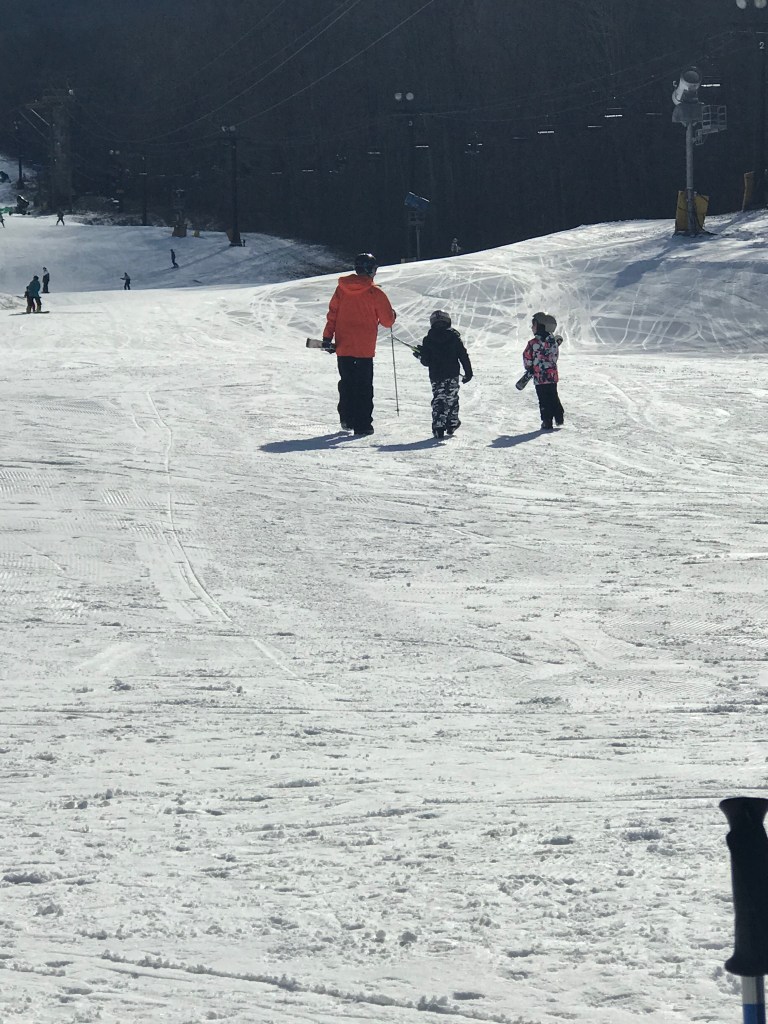
The vacation went as expected. There were many beautiful moments where I actually felt “normal.” We all enjoyed an archery lesson where my children respected the rules, worked hard, smiled, got excited by their accomplishments, and posed for frame-worthy pictures. We went swimming in the indoor pool where we laughed, celebrated aquatic skills, took appropriate risks, and made friends with other children. We went ice skating where my daughter attempted arabesques, my son was considerate of other skaters and their space, and both children marveled at how much better and more confident they became with each lap around the rink. The children went skiing where they focused on directions, fell without getting frustrated, and where my son took a ski lift for the first time by himself (note: this was a Daddy approved move while Mommy was inside getting hot chocolate) skiing down like a champ while engaging in meaningful conversations with others on the hill (he reported that he met a boy from Richmond and they discussed how long it took each of them to get to the resort). And we had family meals where the children stayed seated, used manners, and engaged in conversations with us (NO electronics!).

But as is our reality, “normalcy” is always peppered with struggles to follow conventional expectations and behavior. And when I say this, I do not mean the typical struggles that 8-year olds and 5-year olds exhibit. Typical siblings argue…but after asking my daughter to give him her stick so he could roast a marshmallow at the ski lodge and her not responding immediately by surrendering the stick, my son lost his s*&% screaming at her and trying to punch her. When I intervened, he then tried to punch me. Typical children are disappointed when they do not get their way…but after hearing that they could not ski on Saturday and would have to wait until Sunday, my son called us liars while spitting venom and throwing his weight around refusing to listen to any of our reasons for why this was the case. Typical children feel sad when it is time to go home and there was not time to everything we wanted…but when it was time to leave without having gone on a hike, my son left the hotel in anger to go fishing on his own.

And here’s the thing…others don’t notice and acknowledge the “normal,” they only pay attention to the behavior outside of the norm. They are quick to give you dirty looks, move themselves and their children away from you, or pass judgement on your parenting when they see your children NOT doing what is expected.

As parents, we have two major obligations here…to take care of ourselves in these situations…be ducks with the water rolling off of our backs (sometimes easier said than done). And to take care of our children, that they do not feel the judgement of others, but rather our unconditional love and understanding through these struggles. So, if you see children outside the norm, please always remember that there is a story you do not know and there are parents who are working their a#$es off to help them. Offer your grace and support and remember that “normal” is subjective…it’s a moving target…and it undermines the ways in which we need to be there for all children to support them on their journey.

But your daughter is fine, right?!

I so wish that the answer to that question was yes. But the reality is she is facing her own trauma demons. “A” was four days old when we brought her home from the hospital. So, yes, she avoided the trauma of living in a dysfunctional abusive home that was riddled with drug use. In that sense, she is the winner. But the reality is that losing your birth mother is still a traumatic event. And being exposed to drugs in utero has a lasting effect even if you never experienced the trauma of being raised by parents who struggle with drug addiction.

We continue to learn about these lasting impacts on A’s development. She does struggle with personal space and has sensory issues – she seeks sensory input (extra strong hugs, kisses, constant need for touch, and seeking rough play). There were several reflection sheet that came home during this kindergarten year citing kissing, puddle jumping, and other sensory struggles. We did take her to OT (occupational therapy) for the better part of kindergarten to help with these issues. They eventually called her a “success” and released her from services, but we recognize that, as her parents, we need to continue to work on these issues in social situations.

There are also times where she struggles to follow directions – we could argue that this is typical of a 5 year old – but we need to remain vigilant that there might be more at play here. We can never let our guard down…our children’s development and well-being depend on us constantly questioning and being on-top of issues that might emerge. It is exhausting…

In addition, our daughter has to come to terms with what it means to be in the same space as her (biological half-) brother. She is often traumatized by his behavior and struggles to figure out where she fits into the complex dynamics of our family. Tonight, J had a massive meltdown over not winning a hand of poker (FYI…gambling is the least of our worries! We are teaching our children the concept of odds and how to make smart decisions based on the information you have…pretty important life lesson). While Rob was dealing with J and his emotional meltdown, I sat with A. She grabbed a piece of paper and began writing. She penned the note above, which she wanted to send to God: I love you. Find Jayden peace. She has a loving and forgiving heart. I always want her to see this as a positive and not something that makes her more vulnerable.

Parenting is hard. Parenting children exposed to drugs/alcohol/trauma/etc. is even harder. But we keep going…pushing forward…loving unconditionally…offering unrelenting grace…and praying, that at the end of the day, our love and understanding is greater than the pain and sadness that accompany trauma.

I want to go live with my “REAL” mom!

The simplest explanation is most often correct…clearly William of Ockham never met my son, or any other child impacted by trauma. As my husband was putting him to bed last night, J (VERY!) angrily demanded that Bluebell (one of our beloved and EXTREMELY patient dogs) had to sleep with him or else he would stay awake all night. An outsider observing this interaction and analyzing what was happening using the simplest explanation might conclude:

  1. My son is stalling. He does not want to go to bed and is trying to come up with a plan that will delay the inevitable.
  2. My son is disrespectful. He does not know how to speak kindly to adults – probably a result of too much screen time and/or lazy parenting.
  3. My son is spoiled. He has learned that if he demands something and makes threats about what will happen if we do not deliver on his demands, then we will give in as we always do. (Again…a hallmark of lazy parenting.)

For the record…we only allow T.V. on Sundays (sometimes on a weeknight if it is a special occasion and the children have earned a Family Show Night) and our children do not own devices (i-pads, kindles, etc.) and are not allowed to use our phones. In addition, we do not give in to their demands – we say no…A LOT. Unfortunately, children who have been exposed to drugs in utero (including alcohol) struggle to connect actions to consequences. In other words, the fact that we did not give in to his tantrums the last 100 times does not translate into his thinking that his attempts are futile. (“So you’re saying there’s a chance!” [Dumb and Dumber reference for any fans out there!]) And if lazy means spending every waking moment learning about my children’s multiple “labels” by reading, attending webinars, and going to therapies, watching their diet, homeschooling while teaching 4 graduate courses and writing a book, all while being intentional about helping them process their complex feelings…then, yeah, I am lazy.

New piece of data…when we do not produce Bluebell as demanded, my son then bursts into tears saying that we are the worse parents in the world, that we do not deserve him, and that he wants to go live with his “real” mom. Might this be another attempt at stalling by making us hurt and angry enough to engage in the fight…maybe. But we are veterans at this point, and we know better.

I decided to use a strategy that our amazing adoption specialist therapist introduced to us. I call it the “I Wonder If” strategy. So I come back with, “I wonder if it was difficult for you to have Baby J here today because it made you think about your own story?” (Baby J is our foster cousin whom we LOVE and upon whom my children dote!) His response was a grunt as he buried his head in the pillow. Aha…I was getting closer to the real explanation, which as it turned out, was not at all simple. My son began to sob.

One of the things about J is that he loathes talking about his feelings. I realized that I had struck a chord, and I knew that it would be counterproductive – at that point – to make him engage in a conversation. I said, “I love you buddy! It must be so difficult to see this baby who is looking for a forever family and be reminded of your own journey to find a forever family. It must make you think of your birth mom. And it must be hard that Mommy does not have stories from when you were as little as Baby J. But I am here, and I will hold you.” (Side note: Baby J is getting fitted for a helmet to round out his skull, and J asked us a lot of questions about whether or not he had a helmet as a baby. When we don’t have answers for him, he usually makes up a story about what he remembers – so, according to him, he also had a helmet as a baby.) In typical J fashion, he refused the invitation to be held, but he did relax his body into the pillow and within 5 minutes was asleep. And so, it was not as simple as what was observed on the surface. It took us a LONG time to figure that out, and we are still learning how to navigate these complex waters.

At this point, I can imagine the questions that are swirling around in your heads…but he said he wanted to live with his “real” mom:

  • Does he still see his birth mom?
  • Why?
  • Doesn’t that confuse him?
  • Doesn’t it make it more difficult for him?

In short:

  • Yes
  • Because it is important
  • No
  • No

Here is the reality…whether or not he sees her, he thinks about her all of the time. He has told me as much on multiple occasions throughout his life. He was 16…almost 17…months old, and YES, he remembers. Do you think that if you were yanked out of the only life you knew, you would really forget? How fair is that to ask of you? J’s identity lies partially with his first family, and we MUST honor that and help him understand it. Is it hard at times? ABSOLUTELY! He is 8 and is still trying to figure out how to articulate and appropriately express his feelings. But that is life, and that is our responsibility as his real 🙂 parents.

We are blessed in our relationship with birth mom. We realize that we only see her 2-3 times a year and therefore only “know” her based on 6-9 hours of interactions a year. But we have no doubt that she loves our (the collective our – hers and our) children. She is working so hard…writing up her story for them, providing pictures of relatives so our children can see their faces in others, and providing a book for our son to document questions he has for her that she can answer at our next visit. I cannot even begin to imagine how she feels, losing a part of herself. And I can’t begin to imagine how my son feels, loving two women – both of whom care for him in the best way they know how – and worrying that love for one might diminish his love for the other or struggling with his anger at one, but only having the other to shoulder the brunt of that pain.

In the foster/adoption realm, there is no simple explanation. There is only digging deeper, forgiving more freely, and loving more fiercely.

Self-Care is More Than Just a Platitude

The one consistent advice I have run across on this foster care/adoption journey is self-care. I read a lot about it over the years (blogs, articles, books, etc.), but for some reason it did not click for me until winter break 2019-2020 (7 years into this journey!). Perhaps I thought I was above all of that…I am a doctor for God’s sake, I know what I am doing…clearly I do not… (another topic for another post). Parenting these children has been the most humbling experience for me. Everything I thought I knew about child development and learning has been challenged by the pesky realities called trauma and drug exposure. They are game changers, people, and follow none of the rules that us typically developed people cling to so desperately.

Prior to the holidays I was extremely depressed by my weight and physique. I began a health and wellness plan in November (after apple season ended) and have been going strong(ish) ever since. I started eating better and cut out all sugars and (most) alcohol. I started reading about health and wellness (reading after all is the super power of people with Ph.D’s), and am now working on re-incorporating exercise and journaling to support my journey to a healthier, better me.

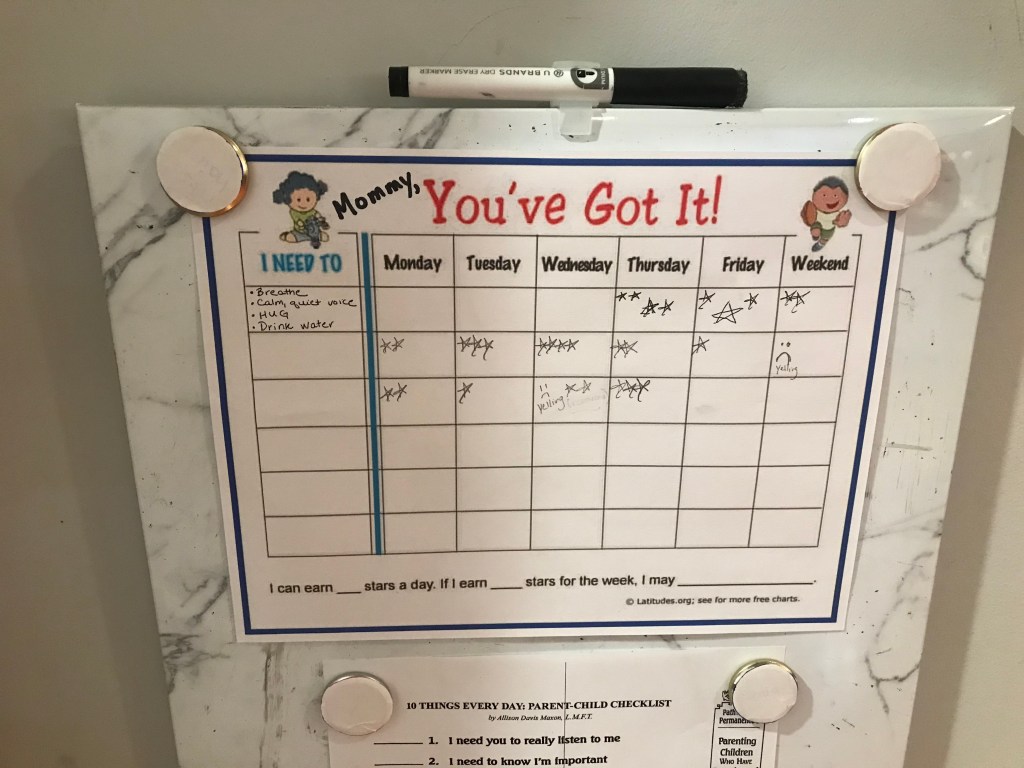
And, because reading is my super power, I have been seeking out the expertise of those who have walked this path before me. I stumbled upon Jennie Owen’s book, Dancing with a Porcupine, one of the most relatable texts I have ever read. In her story, among many other insightful anecdotes, she talks about creating a sticker chart for herself. Our children who have experienced trauma DO NOT CARE about sticker charts – I have ample evidence (as do other foster/adoption parents) to support this, but the truth is, I LOVE stickers/stars/recognition that I am doing the right thing. (One of the “rules” that is so ingrained in me, yet mean NOTHING to my children who have experienced trauma.) So…I created a Star Chart for myself (didn’t feel like spending money on stickers…stars made with a pen are free!). I decided to give myself a star anytime I responded to my child’s behavior with a calm, quite voice, with stopping to take calming breaths, with hugging even when I wanted to do quite the opposite, and with drinking water even when I wanted to drink something a bit stronger. I realized that I needed to acknowledge the hard work I was doing AND to be accountable to my struggles.

Focusing on me has definitely made a difference in my interactions with my children. If we don’t take care of ourselves, how can we possibly take care of others? In a weird way, this blog is also part of my self-care. While I really do hate to write, I also recognize the healing power it has over me. Maybe that’s why I hate it…it forces me to face issues I could otherwise ignore. And, if you ask my parents (LOVE you Mom & Dad!!!), I do tend to internalize my feelings. Writing allows me to get them out there without the awkwardness of hearing people’s immediate reactions to my thoughts/feelings. I don’t want to be “fixed” or “comforted”…I just want to be heard.